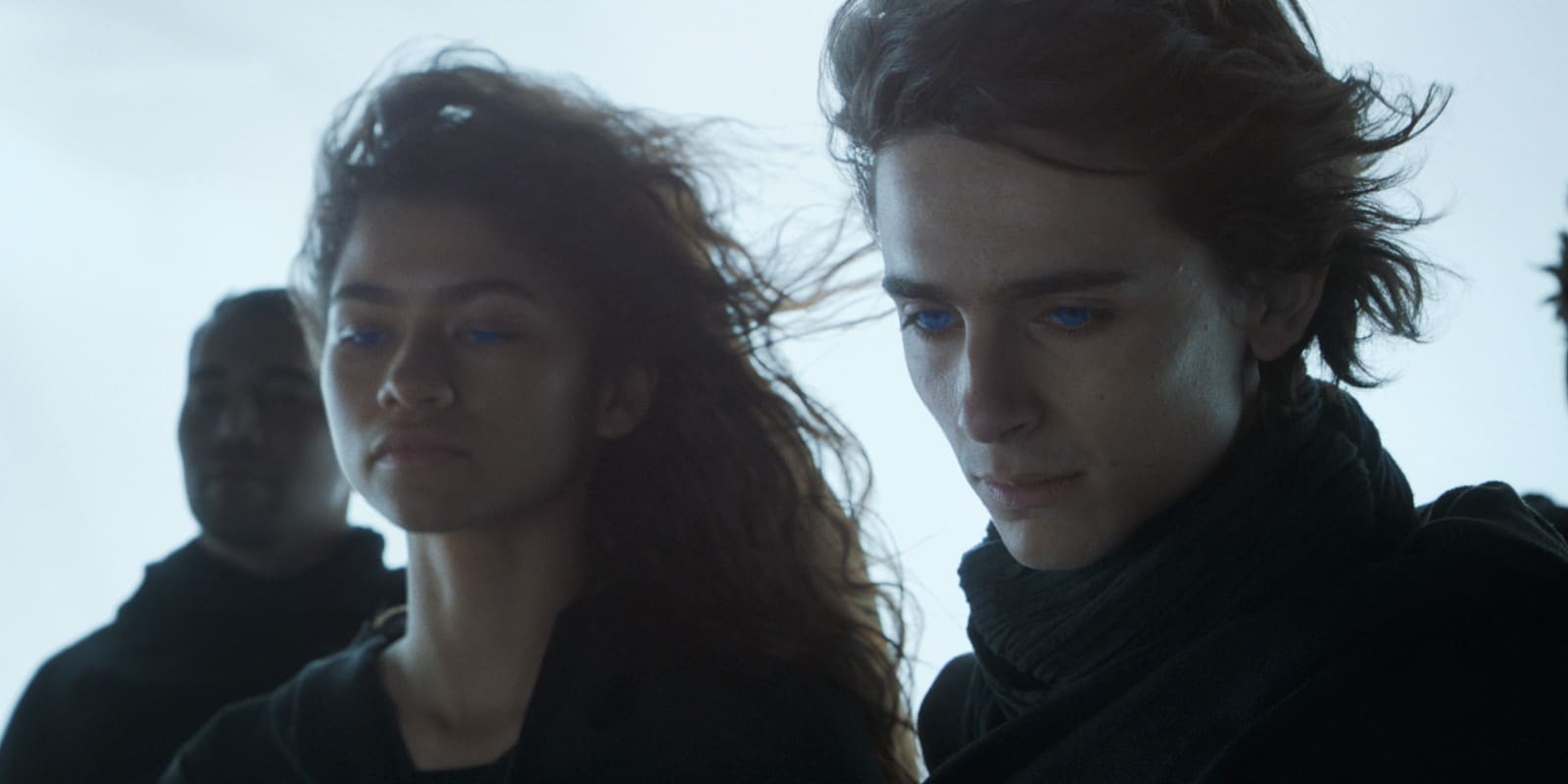
“Where the fear has gone there will be nothing. Only I will remain.”
Arguably my most anticipated since the advent of 2020, Dune finally makes its way into theatres, more than living up to the hype and delivering a satisfying cinematic movie going experience.
Directed by Denis Villeneuve, and based on the classic 1965 science fiction novel by Frank Herbert, Dune follows the rivalry between the Noble Houses of Atreides and Harkonnen battling over control of the desert planet Arrakis, which supplies a substance known only as the “spice”, valued throughout the universe. Caught in the cross hairs of this conflict is the scion of House Atreides, Paul, who must must accept his destiny as a prophesised messianic figure for the planet of Arrakis and battle the Harkonnens.
A lifelong passion project for the director, Dune greatly benefits from Denis Villeneuve’s love and reverence for the source material, lore and world as created by Herbert in his novels. Unlike the 1983 adaptation by David Lynch – which rushed through the dense narrative – Villenueve’s adaptation presents the first half of the novel, thereby allowing the mechanics of the story to breathe as the director maps out the characters, settings, and the mythology present within the book, while planting the seeds and hinting at what is to come in the latter half of the story.
While Dune primarily falls in the science fiction genre, it takes a backseat to the themes of ecology, indigenous oppression, the exploitation of natural resources and the numerous political motivations that underscore them – all themes that were as prevalent back in 1965 as they are relevant now. Villeneuve also updates the gender roles present within the novel, giving them prominence and more character (as seen in Rebecca Ferguson’s Lady Jessica), whilst also gender-swapping a character from the novel (Sharon Duncan-Brewster’s Dr. Liet-Kynes).
Despite presenting a slow-burn story that focuses on its characters, Dune is the rare film that acts as a bridge between the niche and the blockbuster, packed to the brim with awe-inspiring scope and ambition. Coupled with a singular directorial vision not seen since perhaps Peter Jackson’s The Lord of the Rings, Dune immediately envelopes the audiences into its awe-inspiring and meticulously constructed world, while also keeping the story’s proceedings exciting and dynamic through the film’s action sequences.
Dune‘s staggering and gargantuan scope is supported by a “melange” of artists who come together to craft a production design that is flawlessly executed. Every single element on screen (ranging from architecture, vehicles, costumes, sets and props) feels practical, real, tactile, and greatly accentuated by seamless CGI.
Cinematographer Greig Fraser strong visual eye forms the backbone of the film, enticing the viewer from the very first shot to the end, resulting in a film that is gorgeous to look at. Fraser treats the film as a large visual canvas, and is effortlessly able to convey the giant scope of the film through vantage and drone shots. “Every frame a painting” indeed.
Composer Hans Zimmer (a lifelong fan of the source material alongside Villenueve) succeeds in capturing the alien nature of the film’s story through his musical score. While it may be a disappointment to some when heard in isolation, Zimmer’s score stands out at specific moments when complimenting the film, imbuing the film with more life, and enthralling the audience in the process.
Alongside the behind-the-scenes artists, Villeneuve’s skillfully assembled ensemble cast in front of the camera also do their best to support the director’s vision.
Timothee Chalamet, Rebecca Ferguson and Oscar Isaac give some of the best performances of their careers as Paul Atreides, Lady Jessica and Duke Leto Atreides respectively, which lends more credence to their talent and prowess.
It is however, the performances of Stellan Skarsgard as Baron Harkonnen and Jason Momoa as Duncan Idaho that prove to be the standouts in the film, making the most of their limited screen time.
Given the nature of Villeneuve’s adaptation, viewers may be disappointed by the lack of screen presence of certain actors and characters (such as those of Zendaya and Javier Bardem as Chani and Stilgar, respectively), and the film might drag in certain sections. Nonetheless, by the time the credits start rolling, Villenueve ensures the viewers are left wanting more and on the edge of their seats waiting for the sequel.
As a blockbuster, Dune proves to be a relieving alternative to contemporary films of a similar nature, that reminds us of the wonder of film, the grandeur of film making and the magic of the movie going experience.
Dune is certainly a stellar achievement, being one of the best cinematic offerings of the year, alongside Denis Villeneuve’s strongest and best work, cementing the director as a pioneer and maestro of modern-day science fiction cinema.
 Texts of A Pop Culture Buff
“Paul.”
Excellent review of an excellent film, my man!
LikeLiked by 1 person
Very well described. So. Now I must watch this one.
LikeLiked by 1 person
A stellar review of a stellar cinematic masterpiece. Thanks for writing about, and drawing attention to this work of art, which made us believe in rich cinema all over again.
LikeLiked by 1 person